
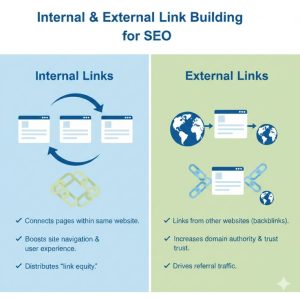
Search Engine Optimization (SEO) is built on many factors, but two of the most important are internal links and backlinks. While both involve linking web pages, they serve different purposes and contribute to your SEO success in unique ways.
Many website owners focus heavily on backlinks while overlooking internal linking opportunities. In reality, a strong SEO strategy requires both. Understanding how they work together can help improve rankings, user experience, and website authority.
In this guide, we’ll explore the differences between internal links and backlinks, why they matter, and how to use them effectively in 2026. Would you like to improve your content writing on your business website?
What Is Internal Linking?
Internal links are hyperlinks that connect one page on your website to another.
Example:
If you have a blog post about keyword research and link it to your Technical SEO Services page, that’s an internal link.
Example URL Structure:
- yourwebsite.com/keyword-research-guide
- yourwebsite.com/services/technical-seo
The link between these two pages is considered an internal link because both pages belong to the same domain.
Benefits of Internal Linking
1. Improves Website Navigation
Internal links help visitors find related content easily, increasing engagement and reducing bounce rates.
2. Helps Search Engines Discover Pages
Google uses links to crawl websites. Strong internal linking ensures important pages are found and indexed faster.
3. Distributes Page Authority
Pages with higher authority can pass value to other pages through internal links, helping improve rankings across your website.
4. Builds Topical Relevance
Connecting related content helps search engines understand your expertise on specific topics.
5. Improves User Experience
Visitors can easily access additional information without searching for it manually.
Internal Linking Best Practices
Use Descriptive Anchor Text
Instead of:
Click here
Use:
Learn more about our Technical SEO Services
Link to Relevant Pages
Only create links that provide value and context to the reader.
Prioritize Important Pages
Frequently linked to:
- Service pages
- High-converting landing pages
- Pillar content
- Key blog posts
Avoid Overlinking
Too many links on a page can dilute their value and overwhelm readers.
What Are Backlinks?
Backlinks are links from another website pointing to your website.
They are often referred to as “inbound links” or “external links.”
Example:
A marketing blog writes an article and links to your SEO guide as a reference.
Because the link comes from another domain, it is considered a backlink.
Why Backlinks Matter for SEO
Backlinks remain one of Google’s strongest ranking signals.
When authoritative websites link to your content, search engines view it as a vote of confidence.
Key Benefits of Backlinks
1. Improve Domain Authority
Quality backlinks help increase your website’s credibility and authority.
2. Boost Search Rankings
Pages with strong backlink profiles often rank higher for competitive keywords.
3. Increase Referral Traffic
Visitors can click backlinks and arrive at your website from other sources.
4. Build Brand Trust
Being referenced by reputable websites strengthens your brand’s reputation.
Types of Backlinks
Editorial Backlinks
Naturally earned links from websites that reference your content.
Guest Post Backlinks
Links earned by publishing content on another website.
Business Directory Links
Links from trusted business listings and local directories.
Resource Page Links
Links from curated pages that recommend useful resources.
Internal Links vs. Backlinks: What’s the Difference?
| Factor | Internal Links | Backlinks |
|---|---|---|
| Source | Same website | Different website |
| Control | Fully controlled by you | Controlled by others |
| SEO Value | Improves site structure and page authority flow | Increases domain authority and trust |
| Cost | Free | Often requires outreach and content marketing |
| Impact | Helps with crawling and navigation | Strong ranking signal |
Both are essential and should work together as part of a complete SEO strategy.
Which Is More Important?
The answer is simple: both.
A website with hundreds of backlinks but poor internal linking may struggle to maximize its ranking potential.
Likewise, a website with excellent internal linking but no backlinks may find it difficult to compete against authoritative competitors.
Successful SEO campaigns combine the following:
- Strong website architecture
- Strategic internal linking
- High-quality content
- Authoritative backlinks
- Technical SEO optimization
How Internal Links and Backlinks Work Together
Imagine backlinks as roads bringing visitors to your website.
Internal links are the roads that guide those visitors to important destinations once they arrive.
For example:
- A backlink points to your SEO blog.
- Visitors land on the article.
- Internal links direct them to:
- SEO Services
- Technical SEO Services
- SEO Audit Services
- Contact Page
This creates a smooth user journey while passing authority throughout your website.
Common SEO Mistakes to Avoid
Internal Linking Mistakes
- Using generic anchor text
- Linking to irrelevant pages
- Creating orphan pages
- Excessive internal links
Backlink Mistakes
- Buying spammy backlinks
- Using private blog networks (PBNs)
- Participating in link schemes
- Prioritizing quantity over quality
Google increasingly rewards natural, user-focused SEO practices.
Conclusion
Internal linking and backlinks are two pillars of modern SEO. Internal links help search engines understand your website structure while improving user experience. Backlinks build authority, trust, and ranking power from external sources.
The most successful websites in 2026 use both strategically. By creating a strong internal linking structure and earning high-quality backlinks, you can improve your search visibility, drive more organic traffic, and build long-term SEO success.
SEO Title
Internal Linking vs Backlinks in SEO: Key Differences and Best Practices for 2026
Meta Description
Learn the difference between internal links and backlinks in SEO. Discover how both impact rankings, authority, and website growth in 2026.
Focus Keyword
Internal Linking vs Backlinks
Secondary Keywords
- internal linking SEO
- backlinks SEO
- importance of backlinks
- internal linking strategy
- link building SEO
- SEO backlinks guide
- internal links for SEO
- backlink strategy 2026
- SEO link building
- website authority SEO