
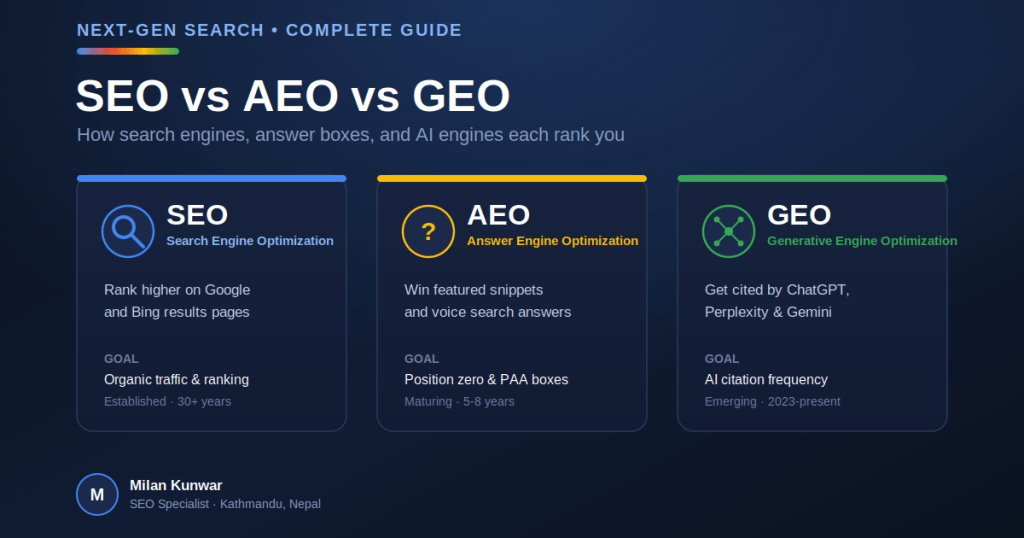
What Are SEO, AEO, and GEO?
Let’s start with clear definitions before diving into strategy. These three disciplines are related but distinct—and each requires a slightly different approach.
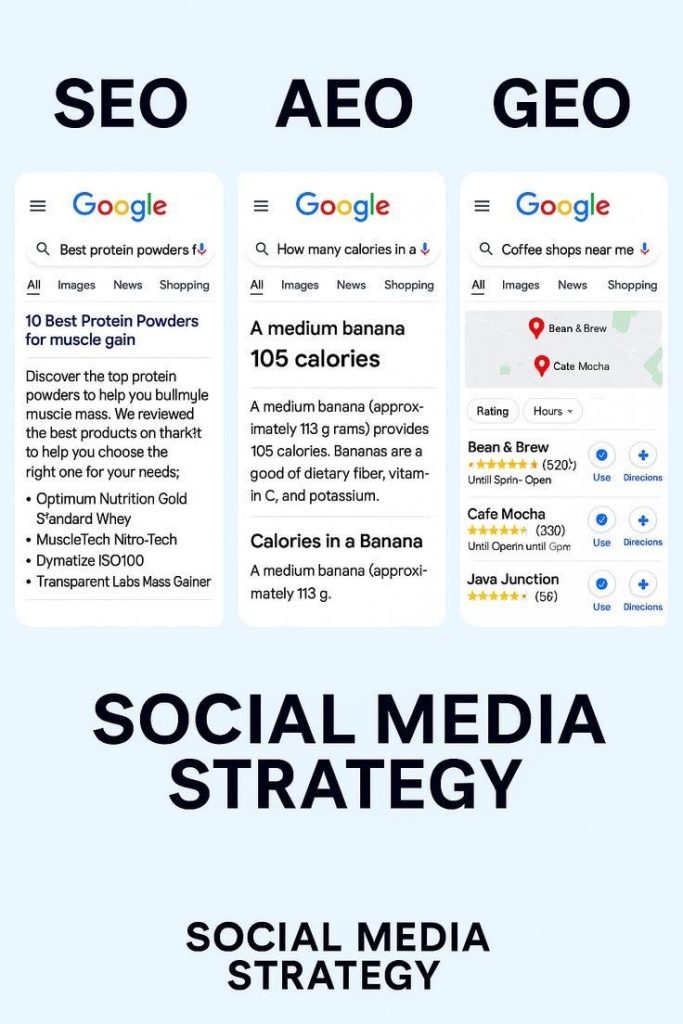
SEO
Search Engine Optimization
Optimizing your website so it ranks higher in Google, Bing, and similar search engines through keywords, backlinks, technical performance, and content quality.
AEO
Answer Engine Optimization
Structuring your content so it gets selected as the direct answer in featured snippets, Google’s “People Also Ask,” and voice assistant responses.
GEO
Generative Engine Optimization
Crafting content that AI tools like ChatGPT, Perplexity, Google SGE, and Gemini cite and recommend when generating responses for users.
Key stat: According to industry research, over 40% of Google searches in 2025 result in zero clicks to traditional websites—answered directly by AI overviews and featured snippets. Visibility in AI responses is no longer optional.
SEO: The Foundation You Can’t Skip
SEO remains the bedrock of online visibility. Without solid fundamentals, neither AEO nor GEO will deliver results. The core pillars of modern SEO are:
1. E-E-A-T: Experience, Expertise, Authoritativeness, Trustworthiness
Google’s quality guidelines now emphasize first-hand experience. Blog posts that show real-world application, case studies, and original insights outperform generic, derivative content every time.
2. Keyword intent alignment
High-indexing content matches the intent behind a search query—informational, navigational, commercial, or transactional—not just the exact keyword phrase. Write content that fully satisfies why someone searched.
3. Core Web Vitals & technical SEO
Page speed, mobile usability, and a clean site architecture remain critical ranking factors. Google rewards pages that are fast, secure (HTTPS), and easy to crawl.
- Use target keywords naturally in H1, H2 headings, and meta descriptions
- Write a meta description under 160 characters that includes your keyword
- Use internal links to connect related content across your site
- Optimize images with descriptive alt text and compressed file sizes
- Build backlinks from authoritative sites in your niche
- Ensure mobile responsiveness and page load under 2.5 seconds
- Add schema markup (Article, FAQ, HowTo) for rich results
AEO: Win the Answer Box
Answer Engine Optimization is about getting your content selected as the definitive answer—in Google’s featured snippet (Position Zero), in voice search results from Siri or Alexa, and in the “People Also Ask” boxes that dominate modern SERPs.
The anatomy of AEO content
AEO-optimized content is structured around questions. Every major section of your article should directly answer a specific query your audience is likely to type or speak. The winning format is a question, a concise, direct answer (40–60 words), and supporting detail.
AEO tip: Format your key answers in a clear paragraph of 40–60 words immediately after the question heading. Google’s featured snippet algorithm prefers paragraph answers for “what is” and “why” queries, and bulleted lists for “how to” and “steps” queries.
Schema markup for AEO
Structured data tells search engines exactly what type of content you have. Use FAQPage schema for FAQ sections and HowTo instructional content, and useArticle Schema with author markup for all blog posts. This article uses all three.
- Frame H2 and H3 headings as questions your audience actually asks
- Provide a concise 40–60-word paragraph answer directly after each question
- Add FAQPage schema markup to your FAQ section
- Use numbered lists for step-by-step processes (triggers How-To snippets)
- Include a “What is?” section near the top of every article
- Target long-tail conversational keywords that match voice search patterns
GEO: Get Cited by AI Engines
Generative Engine Optimization is the newest and fastest-growing discipline. When users ask ChatGPT, Perplexity, Google’s AI Overview, or Gemini a question, those tools synthesize answers from across the web—citing trusted sources. GEO ensures your content is one of those sources.
What makes content AI-citation-worthy?
Generative AI engines favor content that is accurate, well-sourced, authoritative, and clearly written. They’re pattern-matching on the signals they learned to associate with credibility during training.
Critical insight: GEO is less about keywords and more about being the best source. AI models favor original data, expert quotes, specific statistics, and clear definitions over generic content — even if that generic content ranks well on Google today.
GEO optimization strategies
Include original data and statistics
AI engines disproportionately cite content containing original research, surveys, or unique data. Commission a small survey, analyze public datasets, or conduct an experiment — then publish your findings.
Define entities and concepts clearly
Use clear definitions for every key term. AI models are trained to surface concise, authoritative definitions. A well-written “What is X” paragraph is prime citation material.
Build topical authority with clusters
Don’t write one article about SEO. Write 15 interconnected articles covering every angle of the topic. AI models recognize sites with deep topical authority and weight them more heavily.
Get cited by other authoritative sources
AI training data weights pages that themselves appear in other trustworthy sources. Earn mentions on industry publications, academic sources, and established media outlets.
Optimize for Perplexity and SearchGPT
Submit your sitemap, maintain accurate schema markup, and make sure your content is accessible to crawlers. Some generative engines use real-time web crawling, not just training data.
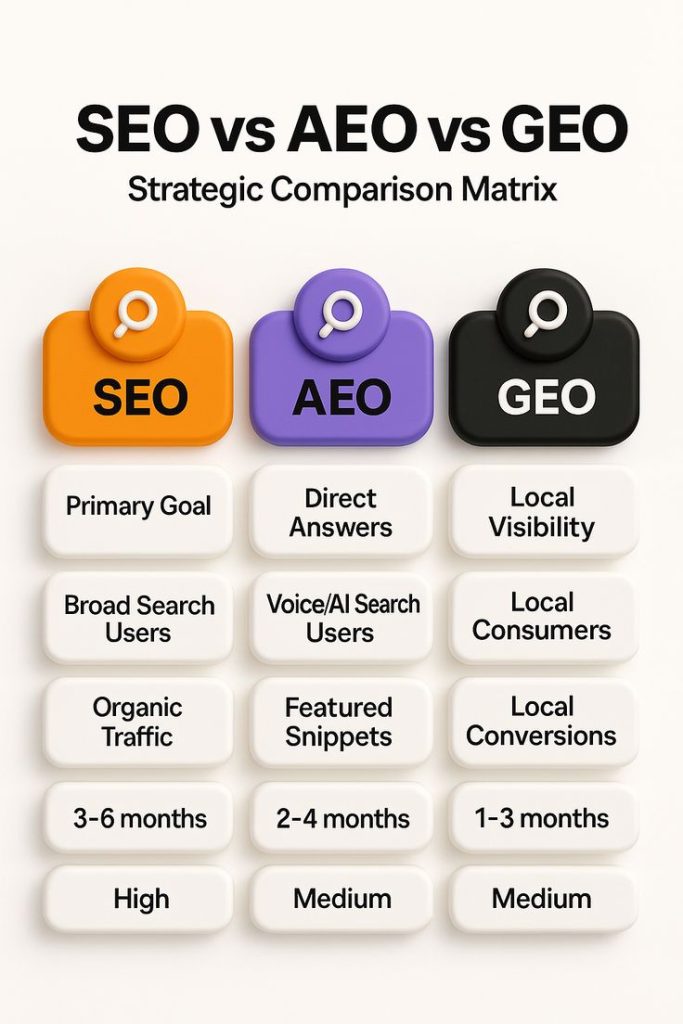
SEO vs AEO vs GEO: Side-by-Side Comparison
| Factor | SEO | AEO | GEO |
|---|---|---|---|
| Primary goal | Rank on search engine results pages | Win featured snippets & voice answers | Get cited by AI-generated responses |
| Key platforms | Google, Bing, Yahoo | Google Snippets, Siri, Alexa, Cortana | ChatGPT, Perplexity, Gemini, Claude, SGE |
| Content format | Long-form, keyword-rich articles | Concise Q&A format, structured data | Authoritative, data-rich, well-sourced |
| Success metric | Ranking position, organic traffic | Featured snippet capture rate | AI citation frequency, brand mentions |
| Technical requirement | Technical SEO, backlinks, Core Web Vitals | Schema markup, FAQ structure | Crawlability, entity clarity, authority signals |
| Maturity | Established (30+ years) | Maturing (5–8 years) | Emerging (2023–present) |
Your Integrated 2025 Content Strategy
The good news: most of the work you do for SEO also benefits AEO and GEO. The goal is a layered content system that maximizes visibility across all three channels simultaneously.
Start with a pillar and cluster content architecture
Create one comprehensive “pillar” article per major topic (1,500–3,000 words), then build 8–15 supporting “cluster” articles that link back to it. This establishes topical authority for SEO and GEO alike.
Structure every article for scannable answers
Use question-based H2/H3 headings. Provide a direct 2–3 sentence answer immediately after each heading before expanding. This serves AEO snippets and GEO citations simultaneously.
Add an FAQ section to every article
A 4–6 question FAQ at the bottom of every article, marked up with FAQPage schema, captures People Also Ask boxes (AEO), ranks for long-tail queries (SEO), and provides clean Q&A pairs that AI engines love to cite (GEO).
Include original data in at least 20% of your articles
Surveys, polls, experiments, or original analysis. Even a simple “we analyzed 100 examples and found…” gives AI engines a reason to cite your specific content rather than a generic competitor.
Build your author E-E-A-T signals
A detailed author bio with credentials, social profiles, and published work signals expertise to both Google and AI models. Your byline is now a ranking signal across all three optimization channels.
Frequently Asked Questions
The Bottom Line
Search visibility in 2025 is won on three separate battlefields simultaneously. SEO keeps you visible in traditional results. AEO puts you inside the answer. GEO makes you the source AI trusts.
The brands that treat all three as a unified strategy—not three separate projects—will build a compound advantage that’s nearly impossible for competitors to replicate. Start with strong foundational content, structure it for answers, and make it authoritative enough for AI to cite.
Your content strategy isn’t just competing against other websites anymore. It’s competing to be the trusted source in an AI-mediated world. Build accordingly.